

Blockchain Development & Strategy
Architecting Blockchain-Ready Enterprises
We take organisations from interest to governed implementation: readiness, architecture, controlled pilots, and production-grade DLT systems — with compliance and board clarity from day one.
What Blockchain-ready means
Blockchain-ready is not “launch a token tomorrow” or “buy crypto”. It means your company has:
clear governance & policy
We help define who decides, who operates, and which rules apply before any ledger goes live — so blockchain is an operating choice, not an uncontrolled experiment.
KYC/AML readiness where required
Where regulated flows are involved, we map identity, screening and Travel Rule / AML posture into the operating model, so on-chain steps do not outrun compliance.

a defined custody / wallet model
We clarify how keys, accounts and assets are held — bank rails, custodians, Multi-Sig or MPC — before mint, transfer or payout logic is designed.
a path to permissioned smart contracts / tokenisation when relevant
When tokenisation adds value, we design allow-listed, audit-ready contracts (e.g. share or process tokens) instead of permissionless “token launches”.

controlled on-chain payment
options if needed
If payments or settlement touch the ledger, we keep them gated, reconcilable and linked to real-world confirmation — not speculative crypto rails by default.

board-level literacy
We equip directors and executives with a clear vocabulary of risks, stages (S0→S5) and decisions, so sponsorship and oversight stay informed.

a route to technical audit before go-live
Before production, we plan review, testing and audit paths so smart contracts and integrations can be challenged — not improvised at launch.
a staged path from discovery to controlled go-live
We structure adoption as S0→S5: discovery and operating model first, then foundation, limited pilot, supervised production and scale — so go-live is a decision, not a leap.

Core offerings
GLOBAL CONSULTANT provides end-to-end Blockchain-ready services: from operating-model readiness to permissioned architecture, pilots and audit-ready build.
Our Core offerings follow the same logic as a serious operating project: first we make the organisation ready to decide, then we design the ledger pattern that fits, then we prove it in a controlled pilot, and only afterwards we harden for production.
Readiness & operating model turns interest into a decision pack — gaps, risks, roles and a staged plan — so sponsors know what “yes” actually commits them to. Permissioned architecture defines who may write, who may read, and how events stay reconcilable across teams or counterparties. Smart contracts & tokenisation are used when a right or process state must become programmable and allow-listed — for example fund shares or certified records — not as a speculative token launch. Integration & pilots connect the design to real systems with a kill-switch and measurable success criteria. Production hardening adds runbooks, monitoring hooks and audit support so go-live is supervised, not improvised.
Together these five offerings are the delivery spine of Blockchain-ready work at GLOBAL CONSULTANT: governance first, technology second, scale only after control.
Readiness & operating model
Gap analysis, risk map, RACI, staged plan (S0 Discovery)
Permissioned architecture
Private/consortium DLT design, identity/allow-list patterns, audit trails.
Smart contracts & tokenisation
Enterprise stacks and permissioned tokenisation — including fund/share flows such as Ringfence when applicable.
Integration & pilots
Sandbox and limited pilots with kill-switch and clear success metrics.
Production hardening
Runbooks, monitoring hooks and technical audit support before go-live.
Staged engagement
Six decision gates from first briefing to ongoing assurance. Most clients start at S0 — nothing jumps straight to mainnet.
S0
Discovery
Assessment of readiness, risk map, RACI and priority use-case.
Output: Go/No-Go to Foundation.
Typical duration: 2–4 weeks.
S1
Foundation
Policies, operating model, vendor/custody choices and architecture baseline before any production ledger work.
S2
Controlled pilot
Limited sandbox or permissioned pilot with kill-switch, success metrics and tabletop of failure/compliance scenarios.
S3
Supervised production
Restricted go-live under defined controls, runbooks and audit trail — not a full-scale rollout.
S4
Scale
Expand processes, cells or volumes only after supervised production proves stable and governable.
S5
Assure & evolve
Ongoing monitoring, change control, periodic technical/compliance review and governed upgrades — so the system stays auditable as the business evolves.
Sector & programme directions
We don’t start from technology slogans. We start from business programmes already structured as playbooks — then we connect them to a governed Blockchain-ready path.


Ringfence —
EIF / PCC
6.1.
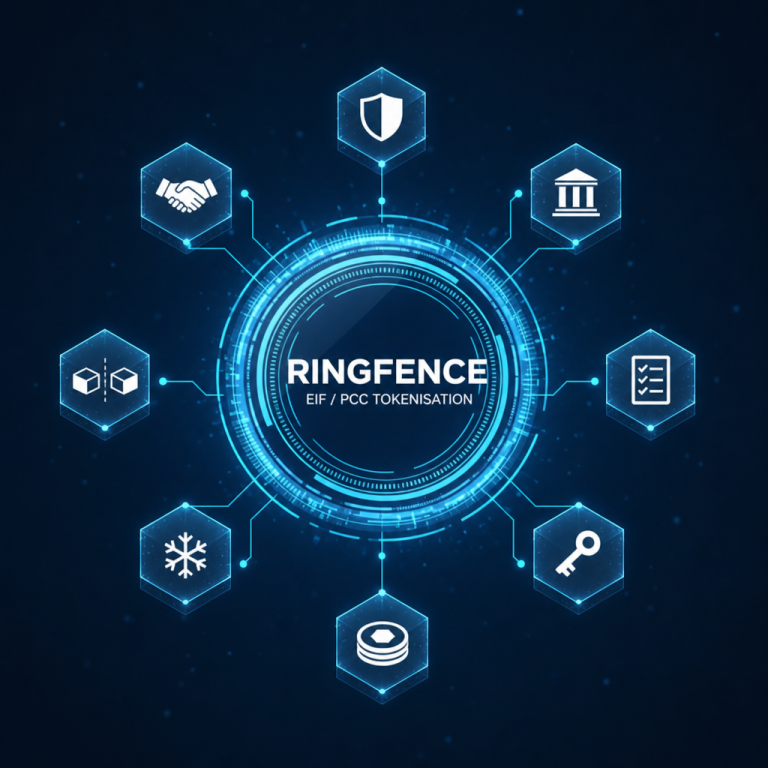
Permissioned share tokenisation for Experienced Investor Funds in a Gibraltar PCC: bank attestation, allow-list, Multi-Sig governance and AML freeze.
Ledger architectures we design
Permissioned private ledger
A controlled network for a single organisation or tightly governed group: clear roles, audit trails and internal process integrity (credentials, records, traceability).
Consortium / multi-party ledger
Shared infrastructure among known participants (companies, banks, administrators, partners) with allow-lists, shared rules and reconcilable events across organisations.
Hybrid Web2 / Web3 architecture
Traditional systems of record and banking rails remain authoritative where needed; the ledger adds controlled mint, transfer, attestation and freeze logic — as in fund or settlement-linked designs.
Public-chain components (selective)
Used only when transparency or interoperability truly requires it — with custody, compliance and risk controls defined first. Never “public by default”.
Tokenisation & smart-contract layers
Permissioned tokens and contract logic for shares, credentials, passports or process states — always allow-listed and audit-oriented when enterprise or regulated use applies.
Not every organisation needs the same kind of blockchain. A ledger is simply a shared, controlled record of events — who did what, when, and under which rules.
On the left you see the architectures we design most often. In plain terms:
• A private ledger stays inside one company (or a very tight group): ideal when you need integrity of internal records without opening the network to outsiders.
• A consortium ledger is shared among known partners — for example a bank, a fund administrator and an operator — so everyone sees the same agreed events, with allow-lists and clear roles.
• A hybrid model keeps your existing systems and bank rails as the source of truth for money and legal records, while the ledger adds controlled steps such as mint, transfer, attestation or freeze.
• Public-chain pieces are used only selectively, when transparency or interoperability truly requires them — never as a default.
• Tokenisation and smart contracts turn rights or process states into programmable, permissioned objects (shares, credentials, passports), always with auditability in mind.
Which pattern fits depends on the sector and the problem: credentials and HR files, real-estate steps, industrial product passports, financial advisory records, fund shares with bank settlement, or regulated trust protocols.
We choose the architecture in S0 Discovery — matched to governance, compliance and operating reality — then connect it to the programme playbooks under Investment Strategy Consulting.
Who it’s for
Blockchain Development & Strategy is built for organisations that need governed adoption — not speculative experiments.
Traditional enterprises
Companies seeking a first controlled pilot: process trust, certificates, traceability or multi-party reconciliation — with clear ownership, policy and a kill-switch before scale.
Finance, fintech & funds
Institutions that need compliance-aware architecture, settlement patterns, permissioned tokenisation and audit trails aligned with operating and regulatory reality.
Banks & settlement partners
Counterparties evaluating a role as attestation, segregated accounts or confirmation authority inside hybrid fund or process designs (for example Ringfence-style flows).
Boards & sponsors
Decision-makers who want board-level clarity on risk, stages (S0→S5) and Go/No-Go gates before committing to build.
Next step
Ready to evaluate whether blockchain belongs in your operating model — safely?
Start with S0 Discovery: readiness, priority use-case and a clear Go/No-Go to Foundation.