
Certified Mining and
Staking Professional
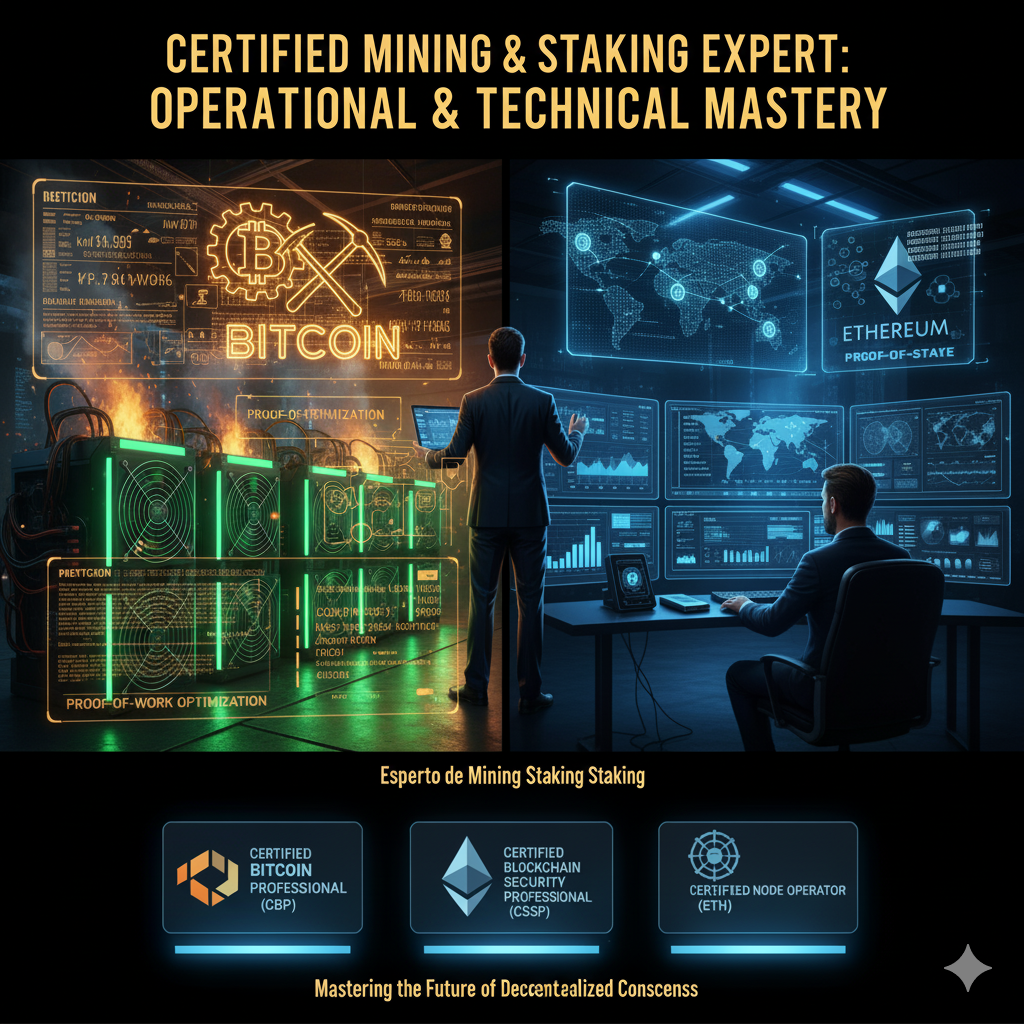
This specialized professional course is designed to transition participants from basic crypto understanding to operational and strategic mastery of the two core consensus mechanisms that secure the Bitcoin and Ethereum ecosystems: Proof-of-Work (PoW) and Proof-of-Stake (PoS).
Core Course Fundamentals
The curriculum provides highly technical, hands-on knowledge required to manage, optimize, and sustain validation and block-production operations in a commercial or large-scale personal capacity.
Dual-Focus Mastery: Gain in-depth expertise in Bitcoin ASIC Mining (PoW), covering hardware procurement, firmware optimization, Mining Pool management, and farm energy efficiency.
Ethereum Validation (PoS): Master the operational side of Ethereum Staking, including validator node setup (Execution & Consensus clients), preventing Slashing (penalties), and analyzing MEV (Maximal Extractable Value) for maximum yield.
Economic Viability: Learn advanced techniques for calculating ROI, break-even points, managing volatile energy costs, and mitigating financial risk in both PoW and PoS environments.
Security & Compliance: Address crucial operational risks, security measures for physical Mining Farms, and the evolving legal and fiscal requirements for reporting mining and staking revenues (e.g., related to MiCA or other regulations).
Certification Readiness
Successful completion of this specialized course provides the comprehensive knowledge base necessary to excel in the following high-value certifications:
Certified Bitcoin Professional (CBP) / Certified Bitcoin Expert™ (CBE): Validates a deep understanding of the Bitcoin protocol, with specific strength in the Mining and network security domains.
Certified Blockchain Security Professional (CBSP): Preparedness for exams focused on securing distributed networks, consensus mechanisms, node validation, and the prevention of attacks or exploits (e.g., Slashing).
Specific Operator/Vendor Certifications: Readiness for technical certifications offered by industry players (e.g., specialized firmware providers, client developers) focusing on ASIC firmware optimization and Ethereum Node Management.
BMEM.1.0 COURSE PROGRAM
Module 1: Economic and Technical Consensus Foundations
(4 Lessons)
This module establishes the foundational knowledge of consensus mechanisms and their economic implications.
Lesson One:
Introduction to Consensus and Incentives
- Understand the function of consensus (PoW, PoS), the double-spending problem, and reward dynamics (block reward, fee structure).
Lesson Two:
Cryptography and Hash
Functions for Mining
- Review of SHA-256 (Bitcoin) and hash functions, entropy, and key generation relevant to the mining process
Lesson Three:
Mining (PoW) vs. Validation (Staking/PoS) Distinctions
- Compare the energy-intensive approach of Proof-of-Work with the capital-backed security model of Proof-of-Stake.
Lesson Four:
The Economics of Fees, Rewards, and Halving
- Analyze how transaction fees and block subsidies affect long-term profitability and the impact of the Bitcoin Halving.
BMEM.1.0 COURSE PROGRAM
2. Module: Technical Deep Dive:
Bitcoin Mining (Proof-of-Work)
(6 Lessons)
Focus on the practical, operational management, and optimization of Bitcoin mining hardware and facilities.
Lesson Five:
ASIC Hardware: Selection,
Efficiency, and Types
- Evaluation of hardware specifications, Joules per Terahash (energy efficiency), and the lifecycle of ASIC miners.
Lesson Six:
Mining Software and Optimized Firmware
- Setup of mining software and specialized firmware (e.g., Braiins OS+), overclocking, and undervolting for performance and efficiency gains.
Lesson Seven:
Mining Pools: Functioning and Payment Methods
- Analyze payment models (PPLNS, PPS, Solo Mining) and criteria for selecting a pool based on size, fees, and risk exposure.
Lesson Eight:
Mining Farm Design and
Management (Environment)
- Critical factors like power supply infrastructure, cooling solutions (air vs. immersion), and noise management.
Lesson Nine:
Profitability Analysis and
Break-Even Point
- Advanced calculation of ROI, managing variable energy costs, and crypto hedging strategies.
Lesson Ten:
Mining Farm Security and
Attack Risks
- Physical and network security measures, protection against DDoS attacks, and prevention of hardware/energy theft.
BMEM.1.0 COURSE PROGRAM
3. Module: Technical Deep Dive:
Ethereum Validation (Proof-of-Stake)
(6 Lessons)
Focus on the setup, maintenance, and optimization of Ethereum validator nodes (Staking).
Lesson Eleven:
Ethereum PoS Architecture: Beacon Chain and Validators
- Understand the roles of the Beacon Chain, slots, and epochs in the block validation and finalization process.
Lesson Twelve:
Staking Requirements (32 ETH) and Node Configuration
- Technical setup of an Ethereum validator node: selecting and configuring Execution Client and Consensus Client software.
Lesson Thirteen:
Solo Staking vs. Staking Pools (Liquid Staking)
- Analyze the trade-offs, risks, and benefits of running a solo validator versus using liquid staking services (e.g., Lido, Rocket Pool).
Lesson Fourteen:
Validator Management and Optimization
- Performance monitoring, Slashing prevention (penalties for double-signing or inactivity), and node maintenan
Lesson Fiveteen:
Yield Strategies and Risk in PoS
- Analysis of Annual Percentage Rate (APR), evaluation of smart contract risk, and capital lock-up considerations.
Lesson Sixteen:
MEV (Maximal Extractable
Value) for Validators
- Understand how validators can technically and ethically optimize transaction sequencing to maximize fee revenue.
BMEM.1.0 COURSE PROGRAM
4. Module: Governance, Risk, and Future of Consensus
(4 Lessons)
Covering regulatory compliance, risk management, and future trends necessary for sustainable operation.
Lesson Seventeen:
Legal and Tax Implications of Mining/Staking
- International and local regulations regarding the reporting of block reward revenue, hardware depreciation, and energy costs.
Lesson Eighteen:
The Future of Proof-of-Work (Energy Recycling)
- Analyze environmental concerns and innovative solutions (e.g., utilizing wasted gas) to make PoW mining sustainable.
Lesson Nineteen:
Staking as a Service and
Centralization Implications
- Evaluate the risks to decentralization posed by the dominance of large institutional Staking Providers.
Lesson Twenty:
Emerging DLT Consensus Trends
- Overview of newer algorithms (e.g., Proof-of-Authority, Proof-of-History) and their potential impact on current systems.
Executive Masterclass:
This format is designed for high-level managers, investors, and decision-makers who require a rapid, high-impact understanding of the economic, risk, and strategic components of running Mining/Staking operations, without needing to perform the hands-on configuration.
- Duration: 2 to 3 Full Days (Highly Intensive).
- Focus: Modules 1 (Foundations), (Economics/Risk), and Module 4 (Governance/Compliance).
- Goal: Strategic overview, quick assessment of financial viability, and managing operational risks.
- Ideal for: C-Level Executives, Senior Investment Analysts, and individuals needing rapid strategic knowledge.
2.800 €
Blended / Part-Time:
This is the standard format, providing the full 20-lesson curriculum depth, allowing participants to assimilate complex technical knowledge while balancing their existing professional responsibilities.
- Duration: 4 to 6 Months (Scheduled synchronous online sessions or weekends + self-paced on-demand modules).
- Focus: All 20 Lessons and associated hands-on practical exercises (e.g., node configuration simulations, ROI spreadsheet modeling).
- Goal: Achieve maximum operational and strategic mastery of both PoW and PoS systems and prepare for all relevant certifications.
- Ideal for: Full-time professionals, IT Managers, DevOps Engineers, and aspiring specialized consultants.
1.800€
Corporate Workshop:
This format is customized for a specific organization or team (e.g., an energy company, a crypto fund, or an IT infrastructure department) to address unique operational challenges and internal context.
- Duration: 1 to 5 Days (Customized based on scope and depth required).
- Focus: Content is highly tailored (e.g., focusing only on ASIC Immersion Cooling or specific Ethereum Slashing prevention protocols relevant to the client’s existing infrastructure).
- Goal: Solve immediate, organization-specific operational or compliance challenges and upskill internal teams.
- Ideal for: Innovation Teams, IT/Strategy Departments, and specialized Investment Funds.
9.000 €