
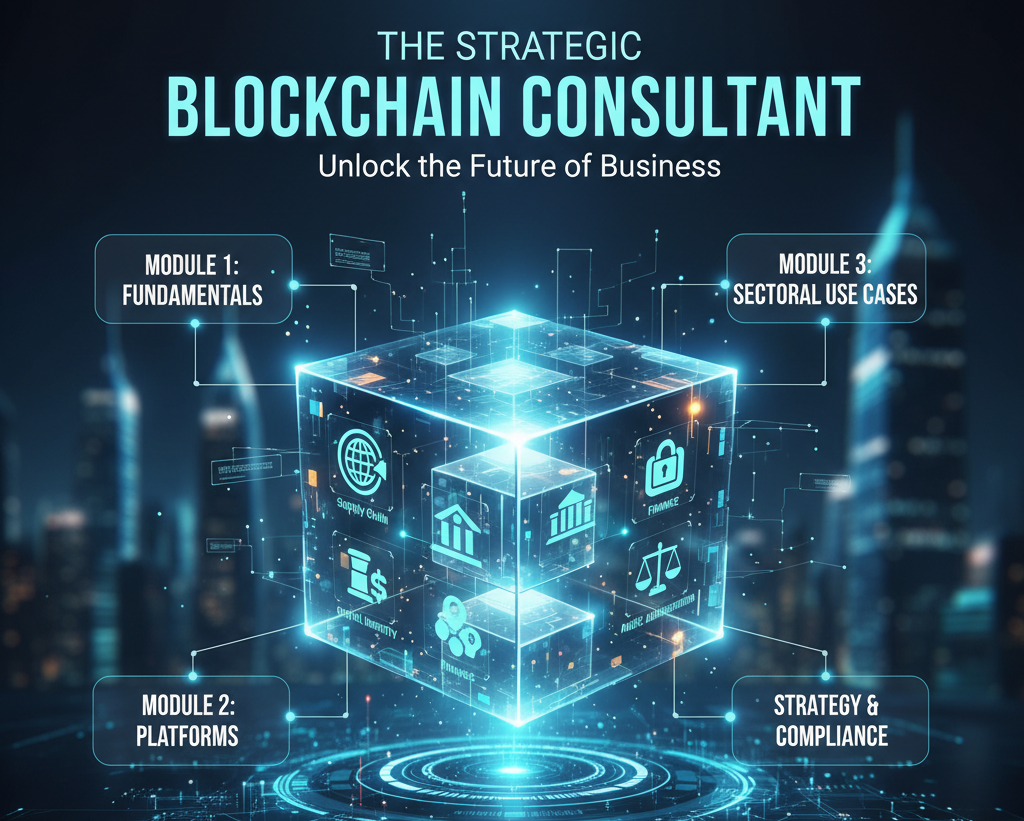
The Strategic
Blockchain Consultant
The modern business landscape is rapidly transforming, driven by the need for greater transparency, efficiency, and security. Blockchain technology and Distributed Ledger Technologies (DLT) are no longer mere futuristic concepts, but concrete tools for reshaping operational processes and business models across every sector.
This intensive course is specifically designed to train Blockchain Consultants ready to bridge the gap between the technical potential of this innovation and the strategic needs of the business.
Program Objectives and Structure
The program is divided into four interconnected modules that ensure a 360-degree preparation:
1. Solid Foundations: From Cryptography to Consensus
2. The Technical Toolkit: Platforms in Action
3. Added Value: Strategic Sectoral Applications
4. From Theory to Practice: Strategy and Compliance
BMEM.1.0.A. COURSE PROGRAM
Module 1: Blockchain Fundamentals and the Consultant's Role
This module establishes the theoretical base and defines the strategic role of the consultant.
Lesson One:
Introduction to DLT and
Blockchain Technology
- Understand key concepts (Hash, Blocks, Mining/Minting), the difference between Blockchain and DLT, and types (Permissioned vs. Permissionless).
Lesson Two:
Cryptography, Consensus, and Security
- Deep dive into consensus algorithms (PoW, PoS, DPoS), public/private key cryptography, and common security risks.
Lesson Three:
Architectures, Smart Contracts, and Tokenization
- Distinction between Layer 1, Layer 2, and Sidechains. In-depth study of Smart Contracts and main token standards (ERC-20, ERC-721, etc.).
Lesson Four:
The Role of the Blockchain Consultant
- Define responsibilities, the consulting process (from strategy to implementation), and necessary soft skills (communication, problem-solving).
BMEM.1.0.A. COURSE PROGRAM
Module 2: Blockchain Environments and Platforms (Technical Overview)
Provides practical knowledge of the main platforms used in an enterprise context.
Lesson Five:
Ethereum and the EVM Ecosystem
- Functioning, costs (Gas), development tools, and Ethereum's role for decentralized applications (dApps).
Lesson Six:
Hyperledger Fabric and R3 Corda
- Characteristics of Permissioned networks (governance, identity, compliance) and when they are preferable for businesses.
Lesson Seven:
Interoperability and Layer 2 Solutions
- Technologies like Polkadot, Cosmos (Interoperability) and Polygon/Optimism (Scalability). Importance for consulting.
Lesson Eight:
The Consultant's Toolbox
- Analysis tools (Block Explorers), development wallets, and cloud platforms for deployment (e.g., AWS Blockchain, Azure Blockchain).
BMEM.1.0.A. COURSE PROGRAM
Module 3A: Sectoral Applications and Use Cases (The Core of Consulting)
This module, organized by sector, is essential for the consultant's ability to identify and propose specific solutions.
Sector A: Supply Chain & Logistics
Lesson Nine:
Product Traceability and Provenance
- Use of blockchain for "producer-to-consumer" transparency, counterfeit prevention, and product recalls.
Lesson Ten:
Optimizing Payments and Documentation
- Smart contract management (automatic payments upon milestone completion) and digitalization of transport documents (BOL).
Lesson Eleven:
Blockchain and IoT (Internet of Things)
- Integration of IoT sensors for automatic and immutable recording of data (temperature, location) on the blockchain.
BMEM.1.0.A. COURSE PROGRAM
Module 3B: Sectoral Applications and Use Cases (The Core of Consulting)
This module, organized by sector, is essential for the consultant's ability to identify and propose specific solutions.
Sector B: Finance (DeFi and TradFi)
Lesson Twelve:
Digital Assets and Real Estate/Financial Tokenization
- Legal and technical aspects of tokenizing real assets (REOs, shares, bonds).
Lesson Thirteen:
Decentralized Finance (DeFi) for TradFi
- Study of Lending, Borrowing, Liquidity Pools protocols and their application in traditional finance contexts.
Lesson Fourteen:
Cross-Border Payments and Stablecoins
- Blockchain solutions for faster and cheaper international payments (e.g., Ripple/XRP, Stablecoin-based solutions).
BMEM.1.0.A. COURSE PROGRAM
Module 3C: Sectoral Applications and Use Cases (The Core of Consulting)
This module, organized by sector, is essential for the consultant's ability to identify and propose specific solutions.
Sector C: Digital Identity and Healthcare
Lesson Fiveteen:
Self-Sovereign Identity (SSI) and Verifiable Credentials
- The concept of owning and controlling one's data. Applications for identity and CV verification (e.g., European EBSI example).
Lesson Sixteen:
Management of Medical Data and Pharmaceuticals
- Blockchain for secure and consented sharing of medical records and drug traceability (prevention of counterfeit medicines).
BMEM.1.0.A. COURSE PROGRAM
Module 3D: Sectoral Applications and Use Cases (The Core of Consulting)
This module, organized by sector, is essential for the consultant's ability to identify and propose specific solutions.
Sector D: Public Administration and Voting
Lesson Seventeen:
Cadaster Management and
Public Registries
- Use for transparency and immutability in managing property titles (land registry).
Lesson Eighteen:
Electronic Voting (E-Voting) and DAO Governance
- Feasibility and challenges of digital voting via blockchain. Structure and functioning of Decentralized Autonomous Organizations (DAOs).
BMEM.1.0.A. COURSE PROGRAM
Module 4: Strategy, Feasibility Analysis, and Implementation
This final module transforms technical knowledge into consulting capability.
Lesson Nineteen:
Blockchain Return on
Investment (ROI) Analysis
- Tools and metrics for calculating added value, implementation costs (CapEx, OpEx), and TCO (Total Cost of Ownership).
Lesson Twenty:
Evaluation Framework (PoC vs. Pilot vs. Production)
- How to guide a client through the adoption phases: from Proof of Concept (PoC) to production implementation.
Lesson Twentyone:
Legal, Regulatory, and Compliance Aspects (FATF, AML, MiCA)
- Overview of global regulatory frameworks (especially MiCA in Europe) and compliance (KYC/AML) in the enterprise context.
Lesson Twentytwo:
Risk Management and Project Security
- Identifying risks (51% attacks, Smart Contract bugs, governance risks) and planning mitigation strategies.
Lesson Twentythree:
Practical Exercise (Case Study)
- Consulting Simulation: Analysis of a real business problem, proposal of a blockchain solution (platform, architecture, token), and presentation to the "client".
Executive Masterclass:
This format is designed for senior leaders, C-level executives, and experienced managers who need a rapid, high-level understanding of blockchain's strategic and financial implications. The focus is on strategy, governance, and investment return (ROI), rather than deep technical coding.
- Duration 3 to 5 Days (Intensive, Full-Time)
- Pace Highly Accelerated, immersive learning.
- Focus Modules 1 (Fundamentals), 3 (Sectoral Use Cases - Strategic), and 4 (Strategy & Compliance).
- Characteristics In-Person or Live Online: Premium, highly interactive sessions. * Case Study Driven: Focus on real-world business cases, risk management, and regulatory frameworks (MiCA). * Peer Networking: High-level interactions with industry peers. * Key Deliverable: Developing a top-level DLT adoption strategy roadmap.
- Target Audience C-suite executives, senior VPs, Department Heads, and Venture Capital professionals.
3.500 €
Blended / Part-Time:
This is the most comprehensive and flexible option, suitable for professionals and consultants who need both the strategic overview and a detailed technical understanding of platforms and implementation. It combines self-paced study with live sessions.
- Duration 6 to 12 Weeks (Part-Time) PaceStructured, with a mix of self-directed and instructor-led learning. Typically 5-10 hours/week. Focus All 4 Modules (Fundamentals, Platforms, Sectoral Use Cases, Strategy & Compliance) in full depth.
- Characteristics* Asynchronous Content: Pre-recorded lectures and readings for self-paced study (Modules 1 & 2 details).
- Synchronous Sessions: Weekly live online sessions or weekend classes for Q&A, detailed case studies, and practical exercises (Modules 3 & 4 focus).
- Practical Project: Mandatory final project (e.g., a complete Feasibility Analysis on a chosen sector).
- Certification: Leads to the official "Certified Blockchain Consultant" designation.
- Target Audience Mid-level consultants, Business Analysts, IT Project Managers, and aspiring Blockchain Professionals.
3.000€
Corporate Workshop:
This format is tailored for a single organization looking to upskill an internal team (e.g., Innovation Department, Legal, or IT). Content is highly customized to the company's industry and the specific blockchain platforms they plan to use (e.g., focusing only on Hyperledger Fabric for supply chain).
- Duration2 to 4 Full Days (Flexible Scheduling) PaceIntensive and hands-on, focused on immediate application. FocusHighly Custom: Selection of 2-3 Modules with deep dives into specific use cases relevant to the company's sector (e.g., Finance & Compliance, or Supply Chain & IoT).
- Characteristics* On-Site or Dedicated Virtual Classroom: Exclusive training for the corporate team.
- Internal Case Studies: Using the company's own challenges and data for practical exercises.
- Specific Tool Focus: Deep dive into enterprise platforms like Hyperledger Fabric or Corda, depending on corporate strategy.
- Outcome: Creating a preliminary framework or Proof-of-Concept (PoC) plan for an internal project.
- Target AudienceInternal teams (Strategy, R&D, Legal, IT) within a single corporation.
12.500 €