
Blockchain Infrastructure and Consensus Operations
BMEM
1.0.
Course Key Strengths
Dual-Protocol Mastery (PoW & PoS): Achieve comprehensive operational expertise across the two dominant consensus mechanisms. Master the mechanics, profitability, and risk management for both Bitcoin Mining (Proof-of-Work) and Ethereum Validation (Proof-of-Stake).
Operational & Hardware Optimization: Gain hands-on skills in managing complex infrastructure, including ASIC firmware optimization, advanced cooling solutions (air vs. immersion), and precise calculation of ROI and Break-Even Points for sustainable operation.
High-Level Security and Compliance: Learn to secure valuable digital assets by mastering Key Management, preventing Slashing penalties in PoS, and navigating the evolving legal and fiscal landscape for reporting mining and staking revenues.
Certification Ready: The curriculum is strategically designed to serve as preparation for leading industry credentials, including the Certified Bitcoin Professional (CBP) and specialized Certified Blockchain Security Professional (CBSP) exams.

BMEM
1.0.A
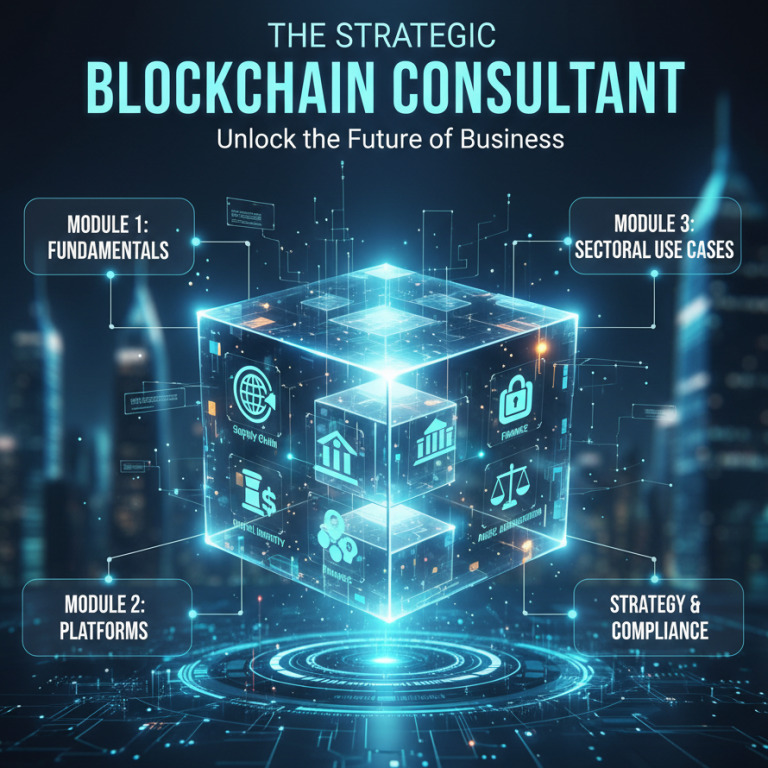
This program is designed to provide comprehensive knowledge, ranging from basic theory to practical application and consulting strategy.
Is specifically designed to train Blockchain Consultants ready to bridge the gap between the technical potential of this innovation and the strategic needs of the business.
By the end of the course, the participant will not only be a technology expert but a strategic consultant capable of guiding companies through the complexity of DLT adoption, transforming operational processes, and generating a lasting competitive advantage.
BMBC
1.1.
This course is designed for executives and strategists to identify, evaluate, and lead blockchain adoption within their organizations.
Use Case Identification: Pinpointing high-value applications across sectors like Supply Chain, Healthcare, and Real Estate.
Feasibility Assessment (PoC): Evaluating the technical and financial viability of a Blockchain Proof-of-Concept (PoC).
Business Model Transformation: Designing new revenue models enabled by decentralization, tokens, and DLT.
Project Governance: Managing internal teams, vendors, and regulatory hurdles during blockchain implementation.

BMBC
1.2.
Focuses on the commercial and market aspects of new digital asset classes and the creator economy.
Non-Fungible Tokens (NFTs): Commercial strategy, legal ownership, distribution, and marketing of digital collectibles and assets.
Asset Tokenization: Fractionalizing real-world assets (real estate, art, commodities) onto the blockchain.
DAO Governance: Understanding Decentralized Autonomous Organizations and their role in future business structures.
Community & Ecosystem Building: Strategies for engaging users and investors in decentralized projects.

BMBC
1.3.
A specialized module focusing on transparency, traceability, and efficiency gains in global logistics.
Traceability & Provenance: Implementing DLT to track goods from origin to consumer, ensuring authenticity.
Supply Chain Transparency: Using shared ledgers to reduce fraud and improve trust among business partners.
Smart Contract Automation: Automating payments, compliance checks, and customs clearance using immutable code.
IoT Integration: Connecting sensor data (IoT) with the blockchain for real-time, verifiable records.

BMBC
1.4.
Covers the practical steps and considerations for large-scale corporate adoption of Distributed Ledger Technology.
Platform Selection: Deciding between platforms like Hyperledger, Corda, or private Ethereum for enterprise needs.
Legacy System Integration: Developing middleware and APIs to connect blockchain with existing IT infrastructure.
Change Management: Training and educating internal stakeholders on new blockchain-enabled processes.
Cost-Benefit Analysis: Quantifying the ROI derived from increased efficiency, reduced errors, and enhanced security.
Blockchain Technical & Development Courses
BTBD
2.1.
Advanced Solidity & EVM Mastery
Mastering techniques for writing highly efficient, low-cost smart contracts. Includes storage optimization, gas metering, and advanced knowledge of the Ethereum Virtual Machine (EVM).
Upgradeable Contract Architectures: Designing and implementing sophisticated contract upgrade patterns (like Proxy Patterns - UUPS, Transparent) to allow for secure, future-proof logic updates.
Full-Stack Web3 Integration: Connecting decentralized application (dApp) frontends (using React/Vue) with the blockchain backend using Ethers.js or Web3.js for seamless user interaction.
Testing & Deployment Tooling: Utilizing professional frameworks like Hardhat and Foundry for advanced testing, network simulation (forking), and scripting complex deployment scenarios.
Decentralized Storage & Oracles: Integrating dApps with off-chain services like IPFS (for storage) and Chainlink (for external, verifiable data feeds) to enhance functionality.

BTBD
2.2.
Enterprise Platform Deep Dive
Comprehensive analysis of permissioned DLT platforms like Hyperledger Fabric, R3 Corda, and Quorum; Focus on their architecture, consensus, and privacy features for corporate use.
Strategic Platform Selection: Mastering the quantitative and qualitative criteria for choosing the optimal DLT solution based on business needs (e.g., transaction volume, regulatory compliance, latency, and required BFT levels).
Architecture and Integration: Designing the complete DLT infrastructure blueprint, including network topology, node operation (on-premise or cloud), and essential API Gateway design for bridging DLT with ERP and other Legacy Systems.
Interoperability and Scaling: Developing robust strategies for connecting the DLT with existing infrastructure; Evaluating and implementing scaling solutions (Layer 2) to maintain high transactional performance in enterprise environments.
Network Governance and Security: Establishing effective Governance Models for multi-party consortiums; Implementing proper security controls, including advanced access and permission management.

BTBD
2.3.
Advanced Smart Contract Vulnerabilities
Detailed analysis of high-severity exploit patterns in EVM code, including Reentrancy, Integer Overflow/Underflow, and logic flaws that compromise contract state or access control.
DeFi & Token Attack Vectors: Understanding specific financial and governance risks, such as Flash Loan attacks, oracle manipulation, and security flaws within major token standards (e.g., ERC-20, ERC-721).
Security Audit Methodology: Mastering the professional four-phase audit process (Inquiry, Analysis, Reporting, and Remediation) used by top security firms to ensure comprehensive coverage.
Automated & Manual Tooling: Hands-on practice with industry-standard security analysis tools like Slither and MythX, combined with effective manual code review techniques and Fuzzing for deep vulnerability discovery.
Infrastructure Security & Key Management: Implementing best practices for operational security, including secure storage for private keys (HSMs), robust Multi-signature (Multi-sig) wallet design, and DApp frontend defense.

BTBD
2.4.
DLT Infrastructure & Containerization: Mastering the deployment and management of DLT nodes and infrastructure components using modern technologies like Docker and Kubernetes to ensure scalability and portability.
CI/CD for Decentralized Systems: Implementing Continuous Integration and Continuous Deployment (CI/CD) pipelines (e.g., GitHub Actions) to automate the entire lifecycle of smart contracts and dApps, from testing to production deployment.
Network Monitoring & Alerting: Setting up and utilizing professional tools (like Prometheus and Grafana) to monitor the health, performance, transaction latency, and gas usage of both public and private blockchain networks in real-time.
Maintenance and Resilience: Designing robust solutions for Disaster Recovery, network backup strategies, and managing automated protocol upgrades to ensure high availability and minimize downtime in critical blockchain environments.
Cloud Infrastructure Setup: Automating the provisioning and management of underlying cloud resources (AWS, Azure, GCP) necessary to support high-performance and resilient decentralized applications.