
The TRU SlotChain Protocol
The End of the Black Box
In an industry built on odds, the only thing that shouldn’t be a gamble is trust. For decades, land-based casinos have operated as "black boxes," asking players to place blind faith in invisible algorithms and closed circuits.
But the world has changed. The digital generation demands more than just a chance to win; they demand the proof of fairness.
Tru-Slotchain is the bridge between the physical thrill of the casino floor and the immutable transparency of the blockchain. We are not just building a new slot machine; we are establishing a new global standard for integrity. By recording the cryptographic DNA of every spin on a decentralized ledger, we are empowering players to verify their own reality.
We are replacing "Trust us" with "Verify us."
This is the future of gaming. Transparent.
Immutable. Tru-Slotchain.
The Market Problem (Why Now?)
Potential buyers (Casinos and Manufacturers) face three costly challenges that this project solves:
- New Player Skepticism: Digital natives avoid traditional slots because they perceive the "House" as manipulative. They prefer crypto-trading or e-sports betting where data is visible.
- Compliance Costs: Proving software fairness to regulators (like ADM, GLI, or MGA) requires lengthy, expensive, and physical audits.
- Hardware Stagnation: Slot machines haven't changed much in 20 years (bigger screens, brighter lights), but the core engine (RNG) remains archaic.
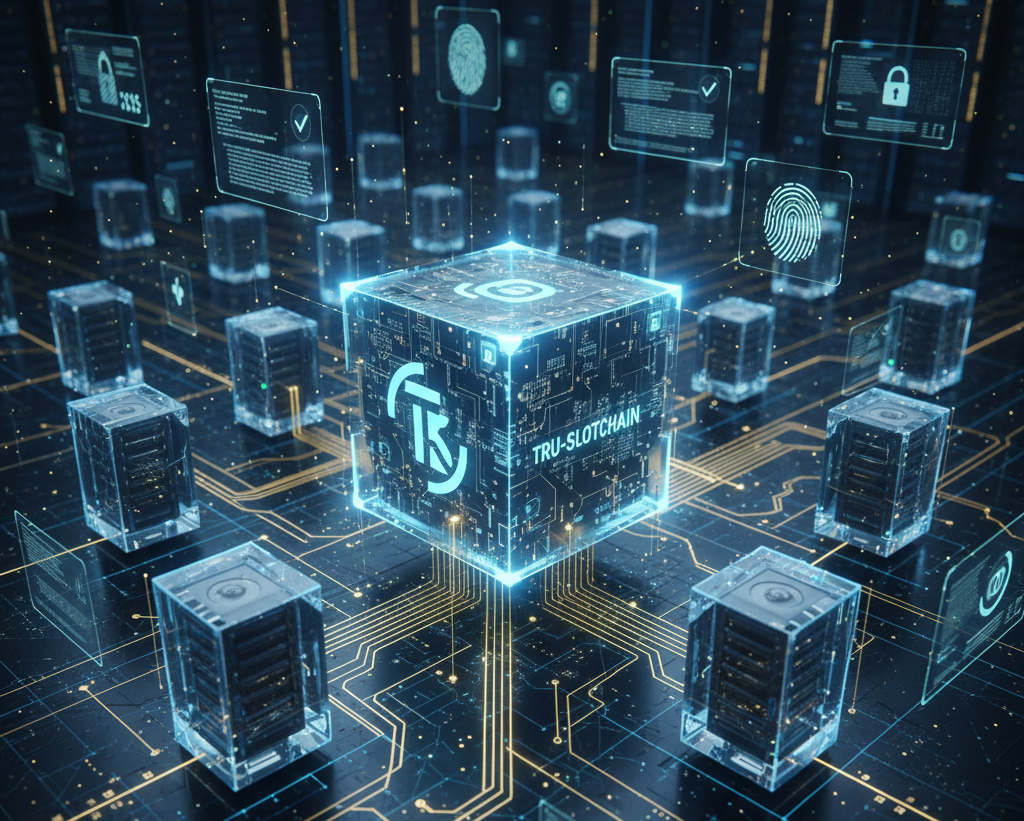
The Solution: "Provably Fair 2.0"
We have adapted the "Provably Fair" concept (standard in online crypto casinos) for the physical world, overcoming the critical issue of network latency.
- For the Player: The game feels identical to a standard slot. No waiting times. If they win or lose and have a doubt, they simply scan a QR Code displayed on the screen. Their phone immediately confirms: "The casino did not cheat. Here is the cryptographic proof."
- For the Casino: The system generates millions of random results in advance (a "Sealed Deck") and records the digital fingerprint (Root Hash) on the Blockchain. No one—not even the casino manager—can alter a result after it has been generated, as the Blockchain would instantly flag the tampering.
Unique Selling Points (Why Buy This?)
Here are the key arguments to convince a B2B buyer:
- A. "Marketing Truth" (Trust as a Service)
- Casinos adopting this technology can launch aggressive marketing campaigns: "We are the only casino where you DON'T have to trust us, because you can check us." This is a massive competitive advantage over traditional venues.
- B. Zero-Latency (Hybrid Architecture)
- Many blockchain projects fail because they are too slow. Our system uses a Local + Asynchronous architecture:
- Game Execution: Happens locally (milliseconds, just like a classic slot).
- Verification: Happens on-chain (on-demand or in the background).
- Result: The reels never wait for the blockchain block to confirm.
- C. Automated Audit & Cost Reduction
- Instead of sending physical inspectors to check machine chips, regulators can operate an observation node on the network. Compliance becomes automated and real-time. If a machine malfunctions or is tampered with, the system automatically isolates it from the network.
Technical Brief (For the Buyer's CTO)
- Core Engine: RNG based on the HMAC-SHA256 standard (Military-grade cryptography).
- Blockchain Layer: Compatible with EVM (Ethereum/Polygon) for public transparency or Hyperledger Fabric for enterprise privacy.
- Integration: Designed as a "Plug-and-Play" module for existing cabinets (via SAS or G2S protocols), requiring no replacement of the entire machine fleet.
- Security: Reverse "Commit-Reveal" Scheme. The result is mathematically predetermined by the server seed but remains unpredictable until the exact moment of the user's input (Client Seed), making it impossible for either the casino or the player to predict or alter the outcome.
Roadmap & Scalability
- Phase 1: PoC (Current Status): Functional prototype running on lightweight hardware (Raspberry Pi) demonstrating the QR Code verification flow.
- Phase 2: Pilot: Deployment on 10 machines within a "Regulatory Sandbox" (e.g., Malta, Isle of Man, or Georgia) to test real-world user engagement.
- Phase 3: Industrialization: Development of the hardware module (black box) to be sold to major slot manufacturers for native integration.
Conclusion for Investors
TRU-SLOT doesn't just sell technology; it sells Trust. In an industry built entirely on credibility, trust is the most valuable asset. We make it tangible, verifiable, and sellable.