
CRYPTO MINING OPTIMIZATION
Strategic and Financial Consulting
Before you invest, it's crucial to define the strategy that best fits your capital and risk objectives.
Feasibility Study: In-depth evaluation of the expected Return on Investment (ROI) based on energy costs, hardware performance, network difficulty, and cryptocurrency price projections.
Risk and Profit Modeling: Creation of financial scenarios that factor in market volatility and events like the Bitcoin Halving.
Hardware Investment Strategy: Guidance on sourcing and purchasing the best ASIC miners (Application-Specific Integrated Circuit) on the market, balancing energy efficiency (J/TH) with purchase price.
Hardware Setup: Assistance with selecting, procuring, and installing miners in your owned facility.
Energy Optimization: Advice on power contracts, cooling solutions (traditional, liquid, or immersion cooling), and thermal management to maximize hardware lifespan.
Pool Selection & Strategy: Analysis of various Mining Pools (e.g., F2Pool, AntPool, ViaBTC) in terms of fees, payment methods (PPS, PPLNS, etc.), and stability.
Connection Optimization: Configuration of miners for maximum efficiency and stable connection to the chosen pool, reducing stale shares and rejected data.
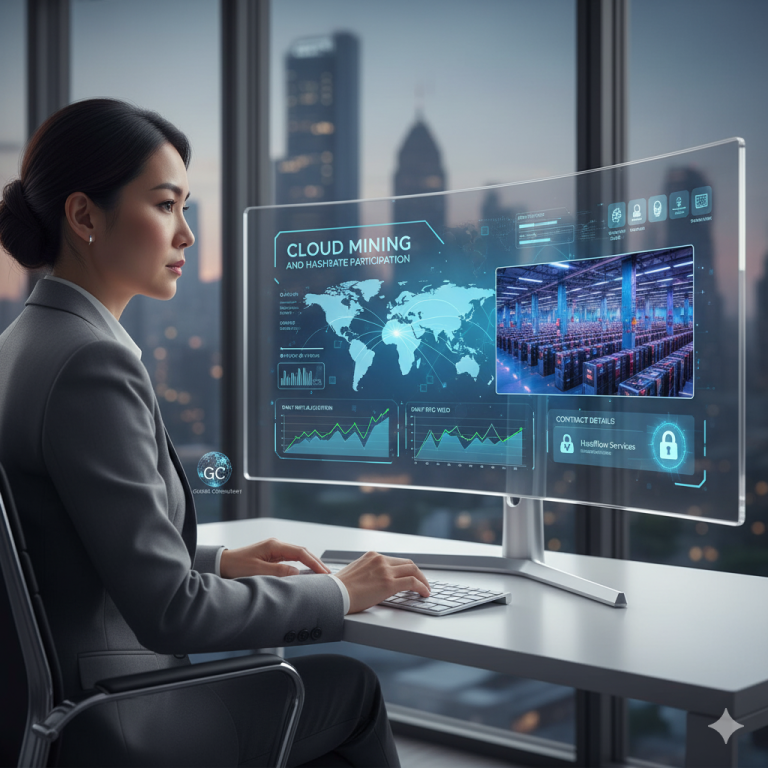
Vendor Due Diligence: Assessment of the credibility and transparency of Cloud Mining contracts and Hashrate providers (participating in computing power without owning the hardware).
Contract Review: Detailed analysis of contract terms, maintenance fees, and uptime guarantees to ensure the yield aligns with your expectations.
Operational and Technical Consulting
We ensure your mining operation maintains peak efficiency over time.
Remote Management: Implementation of remote monitoring and management systems for 24/7 control over miner performance and temperature.
Troubleshooting: Support and maintenance plans to minimize downtime and quickly resolve hardware or network issues.
Difficulty Change Strategies: Strategic advice on adapting operations (e.g., over/underclocking) in response to changes in the Bitcoin network difficulty.
Mining involves managing digital assets. We ensure your activity is secure and compliant with regulations.
SECURITY
Revenue Custody (Self-Custody): Essential consulting on using hardware wallets and Multi-Sig strategies for the Self-Custody of mined Bitcoin, eliminating third-party risks.
COMPLIANCE
Tax and Regulatory Compliance: Guidance on local regulations governing mining operations and the tax requirements for declaring revenue from the sale or holding of mined cryptocurrencies.
Our goal is to give you the peace of mind to operate in a complex sector,
backed by a clear and optimized strategy.
We provide you with advice and development in the three main forms of participation in cryptocurrency mining
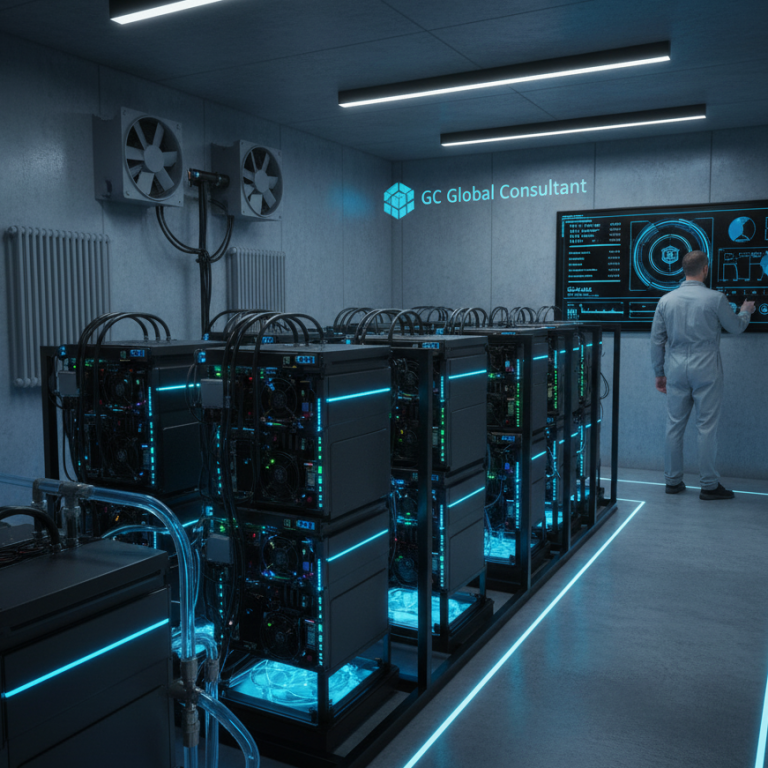
Solo Mining
Mining House
- An individual miner uses their own hardware (typically high-end ASIC or GPU rigs) to attempt to solve the cryptographic puzzle of a new block entirely on their own.
- If successful, the miner receives the entire block reward (plus transaction fees) without sharing it.
- Requires a massive initial investment and has a very low probability of success due in to the extremely high difficulty of major networks like Bitcoin. It is generally only viable for large corporations or those with immense hash power.
Mining Pool
Combine Miners
- Miners combine their computational resources (hash power) over the internet into a larger cooperative group (the pool) to significantly increase their chances of finding a block.
- Higher and more consistent payouts (rewards are small but frequent). Rewards are distributed proportionally to the hash power each miner contributed to the pool.
- The block reward is shared among all pool members, and the pool operator charges a fee (typically 1–3%) for management.

Cloud Mining
Computing Power
- Individuals rent computing power (hash rate) from large, centralized data centers (cloud mining hosts) for a fixed period.
- Zero hardware investment or maintenance. Eliminates the hassle of electricity costs, cooling, noise, and hardware setup, making it the most accessible entry point.
- Lower returns (due to high rental fees and service costs) and security risks (vulnerability to scams or failure of the host company). The miner never owns the physical hardware.